We had a really good time at my parents' house this past weekend. Saturday was spent with the family. We had taco salad stuff for lunch, and Jason made his homemade tortillas for those that wanted burritos...they were yummy! He also made a pan of brownies for my "birthday cake," and we topped it with some (non-dairy ice cream) Cookie Avalanche made by Purely Decadent. It was really good!
Before we served up the brownies, I decided that since it was my birthday (which means I can basically do what I want for the day), I was going to play the "thankful game." You know, the one you usually play at Thanksgiving with your family? So, after they sang "Happy Birthday" to me, I proceeded to name several things that I am thankful for, including my family, Jason and the girls, God's blessings...etc. Then it was my girls' turn to share something they are thankful for. Watch the video clip below to see what they had to say...
My girls made me very proud. Who knew they were capable of keeping secrets at their age. They knew for several weeks and attended church many times and never spilled the beans (as far as we know, that is. Did any of you know?). God's timing is perfect, and we are trusting in Him to work out every detail. We are very excited and feel very honored and blessed that God is entrusting us with another sweet little one. As usual, your prayers are greatly coveted. Right now the due date is set for June 3. So far, I have never made it to a due date. Alyx was 3 1/2 weeks early, and Larissa and Sydney were both 1 1/2 weeks early. I'm imagining this one won't be any different, so we'll be adding another May birthday to the family calendar. =) (For those who don't know, May is the busiest month in our family when it comes to birthdays and anniversaries.)
I hope that none of you are offended that I did not personally call or talk to you, but I felt like this was the fastest and easiest way to get the word out. =)
Showing posts with label Dairy-free. Show all posts
Showing posts with label Dairy-free. Show all posts
Monday, November 10, 2008

Thursday, September 11, 2008
Mexican Cornbread

This recipe was stumbled upon unplanned and was really good! The meal I had planned to fix required a certain ingredient that I didn't have enough of, so I had to change plans at the last minute. We call that a "happy accident." =)
For a while, I had been craving cornbread and just kept forgetting to work it into my menu plan. When I had to come up with a meal at the last minute, I looked in the refrigerator and saw some chopped onions and bell peppers, some jalapenos and our homemade turkey sausage. I also knew that I had some corn in the freezer. We found a cornbread recipe in our recipe book and decided to just throw it all together in a casserole dish to see what would happen. We enjoyed it so much last week, that we decided to make it again this week with a crock pot of beans. We just had it Tuesday night, and it was delicious! (FYI: We cooked a 1 pound bag of dried navy beans [soaked the night before] with some chopped onion, minced garlic and some salt in the crock pot on high for about 6 hours.)

Here's the recipe...Enjoy! Let me know if you try some variations and whether or not you like them.
Cornbread
2 cups all-purpose flour
1 1/2 cups cornmeal
2 Tbsp. double-acting baking powder
2 tsp. salt
2 eggs
1 1/3 cups milk (we use plain soy milk)
4-8 Tbsp. agave nectar (This depends on how sweet you like your cornbread...I used 6 Tbsp.)
2/3 cup oil (We used coconut oil the first time and grapeseed oil the second time. Both worked just fine.)
Ingredients to add to cornbread mixture:
1 1/2 cups turkey sausage
1/2 cup corn
1/2 cup bell pepper, diced
1/2 cup onion, diced
1/3 cup canned or fresh jalapenos, chopped (obviously, less if you don't want it too spicy, more if you want it more spicy.)
This is all we used because that's all we had on hand at the time, but feel free to experiment with additional ingredients. I imagine this would be a good mixture to "sneak" in some veggies that your kids might not eat alone (ie. chopped spinach, diced zucchini or squash, diced mushroom, etc.).
Preheat oven to 375 deg. F. Grease 9" X 13" baking dish (We use grapeseed oil).
Dice and chop pepper, onion and jalapenos and combine with corn and sausage. Set aside.
In medium bowl with fork, mix together flour, cornmeal, baking powder and salt. In small bowl with fork, beat together egg, milk, agave nectar and oil. Pour egg mixture all at once into flour mixture. Stir just until flour is moistened. Do not overstir--It should be slightly lumpy. Add vegetable and sausage mixture to batter and gently combine. Pour batter into the prepared baking dish and spread evenly. Bake 30 minutes or until golden.
Tuesday, August 26, 2008
Raspberry Poppy Seed Muffins (or Blueberry, if you prefer)
This is a recipe that we have adapted from one of our favorite recipe books but have changed certain ingredients to meet our needs. You can make them with either the raspberries and poppy seeds or with just blueberries. This particular recipe can be made with either all-purpose flour, whole wheat flour or a combination of both. If you use whole wheat flour, you will want to increase the baking powder to a total of 4 teaspoons.
Dry Ingredients:
2 cups flour (all-purpose, whole wheat or both)
1 Tbsp. and 1/4 tsp. double-acting baking powder (4 tsp. total if using whole wheat flour)
1/2 tsp. salt (slightly mounded)
2 Tbsp. poppy seeds (omit if making blueberry)
Wet Ingredients:
1 egg
1 cup milk (we use soy milk)
1/4 cup oil (we use grapeseed oil)
1/2 cup agave nectar
3/4 cup fresh or frozen unsweetened raspberries or blueberries (Run the raspberries in a food processor for a few seconds so they will spread throughout the muffins more evenly.)
Directions:
Preheat oven to 400 degrees F. Grease muffin-pan cups or fill muffin pan with disposable cups. Recipe will yield 16-18 muffins.
In large bowl with fork, mix dry ingredients. In small bowl with fork, beat egg slightly, then stir milk, oil and agave into beaten egg. Add fruit to wet ingredient mixture and slightly stir to make sure fruit doesn't clump. Add wet mixture all at once to flour mixture and with spoon, stir just until flour is moistened. (Avoid overmixing which causes toughness; batter should be lumpy.) Spoon batter into muffin cups. Be sure to wipe pan clean of any spills.
Bake muffins 20 to 25 minutes until they are well risen and golden and toothpick inserted in center of one comes out clean and dry.
***Now...this next step is VERY, VERY important!!! =) Do NOT put butter in your muffins! You must, Must, MUST get some coconut oil to spread in your muffins! That is the best stuff you will ever taste, and it is SO much better for you than butter! Try it! =)
Dry Ingredients:
2 cups flour (all-purpose, whole wheat or both)
1 Tbsp. and 1/4 tsp. double-acting baking powder (4 tsp. total if using whole wheat flour)
1/2 tsp. salt (slightly mounded)
2 Tbsp. poppy seeds (omit if making blueberry)
Wet Ingredients:
1 egg
1 cup milk (we use soy milk)
1/4 cup oil (we use grapeseed oil)
1/2 cup agave nectar
3/4 cup fresh or frozen unsweetened raspberries or blueberries (Run the raspberries in a food processor for a few seconds so they will spread throughout the muffins more evenly.)
Directions:
Preheat oven to 400 degrees F. Grease muffin-pan cups or fill muffin pan with disposable cups. Recipe will yield 16-18 muffins.
In large bowl with fork, mix dry ingredients. In small bowl with fork, beat egg slightly, then stir milk, oil and agave into beaten egg. Add fruit to wet ingredient mixture and slightly stir to make sure fruit doesn't clump. Add wet mixture all at once to flour mixture and with spoon, stir just until flour is moistened. (Avoid overmixing which causes toughness; batter should be lumpy.) Spoon batter into muffin cups. Be sure to wipe pan clean of any spills.
Bake muffins 20 to 25 minutes until they are well risen and golden and toothpick inserted in center of one comes out clean and dry.
***Now...this next step is VERY, VERY important!!! =) Do NOT put butter in your muffins! You must, Must, MUST get some coconut oil to spread in your muffins! That is the best stuff you will ever taste, and it is SO much better for you than butter! Try it! =)
Thursday, August 21, 2008
Pumpkin Swirl "Cheese"cake
As I've mentioned before, we are experimenting with some of our favorite holiday recipes, so that when the holidays come, we will be prepared. For those of you who may not already know, Jason is really good in the kitchen. He loves to cook and bake. This ability is very much appreciated, especially when I'm unable to fix a meal. He steps right in and does a great job. =)
One of his favorite things to make is cheesecake. In fact he makes several cheesecakes over the holiday season, so you can imagine our disappointment when we decided to go dairy-free. While we were shopping one day, we came across some soy cream cheese in little tubs just like the spreadable (regular) cream cheese containers. We bought some and began our experiment.
Last year, our favorite cheesecake recipe was a pumpkin swirl cheesecake. (Side note: We later discovered that a spoonful of cranberry relish on top of each slice was really good. The tartness of the cranberries played off of the sweetness of the cheesecake.) Since we are new to using soy products in the place of dairy products, we really weren't sure how it would turn out or if we would even like it. To tell you the truth, I was kind of scared of it. =) To our great delight, though, it was absolutely delicious, and we couldn't tell the difference. In fact, we actually liked the crust better since we used coconut oil in place of butter. The coconut oil really crisps up the ginger snap/pecan crust...yuuuummmmmy!!
My camera did not come out fast enough to get a picture of the cake as a whole...I almost lost an arm trying to get this picture! =)

You have got to try this! It's amazing! We will not be suffering this holiday season...that's for sure. =)

Here's the recipe...
25 Ginger Snaps, finely crushed (We used Mi-Del brand that is only sweetened with dehydrated cane juice.)
1/2 cup finely chopped pecans
1/4 cup coconut oil, melted
4 (8 ounce) packages Toffuti brand soy cream cheese, softened
1 cup evaporated cane juice (ECJ), divided
1 teaspoon vanilla
4 eggs
1 cup canned pumpkin
1 teaspoon ground cinnamon
1/4 teaspoon ground nutmeg
Dash of ground cloves
Preheat oven to 325 degrees F. Mix ginger snap crumbs, pecans and coconut oil; press firmly onto bottom and 1 inch up side of 9-inch springform pan.
Beat (soy) cream cheese, 3/4 cup of ECJ and the vanilla with electric mixer (KitchenAid works fine) until well blended. Add eggs, one at a time, mixing on low speed after each addition just until blended. Remove 1-1/2 cups of the batter; place in small bowl. Stir remaining 1/4 cup ECJ, the pumpkin and spices into remaining batter. Spoon half of the pumpkin batter into crust; top with spoonfuls of half of the reserved plain batter. Repeat layers. Cut through batters with knife several times for marble effect.
Bake 55 minutes or until center is almost set. (Ours took an extra 20 minutes.) Cool completely. Refrigerate 4 hours or overnight. Store leftover cheesecake in refrigerator.
One of his favorite things to make is cheesecake. In fact he makes several cheesecakes over the holiday season, so you can imagine our disappointment when we decided to go dairy-free. While we were shopping one day, we came across some soy cream cheese in little tubs just like the spreadable (regular) cream cheese containers. We bought some and began our experiment.
Last year, our favorite cheesecake recipe was a pumpkin swirl cheesecake. (Side note: We later discovered that a spoonful of cranberry relish on top of each slice was really good. The tartness of the cranberries played off of the sweetness of the cheesecake.) Since we are new to using soy products in the place of dairy products, we really weren't sure how it would turn out or if we would even like it. To tell you the truth, I was kind of scared of it. =) To our great delight, though, it was absolutely delicious, and we couldn't tell the difference. In fact, we actually liked the crust better since we used coconut oil in place of butter. The coconut oil really crisps up the ginger snap/pecan crust...yuuuummmmmy!!
My camera did not come out fast enough to get a picture of the cake as a whole...I almost lost an arm trying to get this picture! =)

You have got to try this! It's amazing! We will not be suffering this holiday season...that's for sure. =)

Here's the recipe...
25 Ginger Snaps, finely crushed (We used Mi-Del brand that is only sweetened with dehydrated cane juice.)
1/2 cup finely chopped pecans
1/4 cup coconut oil, melted
4 (8 ounce) packages Toffuti brand soy cream cheese, softened
1 cup evaporated cane juice (ECJ), divided
1 teaspoon vanilla
4 eggs
1 cup canned pumpkin
1 teaspoon ground cinnamon
1/4 teaspoon ground nutmeg
Dash of ground cloves
Preheat oven to 325 degrees F. Mix ginger snap crumbs, pecans and coconut oil; press firmly onto bottom and 1 inch up side of 9-inch springform pan.
Beat (soy) cream cheese, 3/4 cup of ECJ and the vanilla with electric mixer (KitchenAid works fine) until well blended. Add eggs, one at a time, mixing on low speed after each addition just until blended. Remove 1-1/2 cups of the batter; place in small bowl. Stir remaining 1/4 cup ECJ, the pumpkin and spices into remaining batter. Spoon half of the pumpkin batter into crust; top with spoonfuls of half of the reserved plain batter. Repeat layers. Cut through batters with knife several times for marble effect.
Bake 55 minutes or until center is almost set. (Ours took an extra 20 minutes.) Cool completely. Refrigerate 4 hours or overnight. Store leftover cheesecake in refrigerator.
Thursday, August 14, 2008
Would you believe...?
1. I had been completely off of dairy for several months until this past Monday. Jason had the day off, and we were going to fix our usual "special" breakfast. We decided to make blueberry pancakes and turkey sausage patties with some some peaches on the side. We've been getting a mild turkey sausage (for breakfast) from Whole Foods for several weeks now and really enjoy it. While we were eating, I looked down at one of the sausage patties on my plate that I had already cut into and eaten off of, and there was a little white "globule" about the size of a pea. I asked Jason if he knew what it was, and he said he thought maybe it was just fat. I said that I didn't think so and decided to taste it by itself. Sure enough, it tasted very much like a mild bleu cheese...maybe a feta. I was furious! Evidently, Whole Foods had confused the "specialty" sausage with the mild turkey, or they just put the wrong label on it. As a result, I have had the worst trouble with my sinuses this week and have felt pretty miserable. I'm telling you, this is enough to keep me off of dairy for the rest of my life. The stuff is horrible!!
***Did you know that all it takes is 1 tablespoon of dairy to have you congested for 6-8 weeks?!?***
Because of this incident, I will be trying to make my own turkey sausage in the next week. I have found a recipe and can't wait to try it! =)
2. We locked ourselves out of our house! One day this week, we had to run to the store for something. When we got home, we pulled into the garage, unloaded our stuff and headed for the door to the house. (Let me preface the next statement with this: Maybe I shouldn't announce this on the internet, but we don't lock the door inside our garage. I guess we figure the garage door is security enough, and it's a pain to have to fish out keys when your arms are full of stuff.) When I tried the door and found it to be locked, I immediately filled with "fear."
See, when we moved into this house, we were given 4 (yes, FOUR) keys of which we soon discovered only ONE actually worked. Since I'm at home most of the time, Jason figured he didn't need the key that worked, so he gave it to me. Our system worked...we just used our garage door openers as our "keys" to the house. Here's where our system failed...we had children! =) One of the kids either decided to lock or accidentally locked the door on their way out. I knew that Jason wouldn't have a working key, and I had hurriedly changed purses that morning and had not moved my keys over since Jason was going to be driving. Jason immediately started working to get the door open, and after about 10 or 15 minutes, the door was opened! Praise the Lord!
3. While we were out shopping that same day, we found a world map in the discounted area of Target for only $0.50!! How cool is that? Check it out...

This will be very helpful this year, since Alyx is starting Geography! =)
***Did you know that all it takes is 1 tablespoon of dairy to have you congested for 6-8 weeks?!?***
Because of this incident, I will be trying to make my own turkey sausage in the next week. I have found a recipe and can't wait to try it! =)
2. We locked ourselves out of our house! One day this week, we had to run to the store for something. When we got home, we pulled into the garage, unloaded our stuff and headed for the door to the house. (Let me preface the next statement with this: Maybe I shouldn't announce this on the internet, but we don't lock the door inside our garage. I guess we figure the garage door is security enough, and it's a pain to have to fish out keys when your arms are full of stuff.) When I tried the door and found it to be locked, I immediately filled with "fear."
See, when we moved into this house, we were given 4 (yes, FOUR) keys of which we soon discovered only ONE actually worked. Since I'm at home most of the time, Jason figured he didn't need the key that worked, so he gave it to me. Our system worked...we just used our garage door openers as our "keys" to the house. Here's where our system failed...we had children! =) One of the kids either decided to lock or accidentally locked the door on their way out. I knew that Jason wouldn't have a working key, and I had hurriedly changed purses that morning and had not moved my keys over since Jason was going to be driving. Jason immediately started working to get the door open, and after about 10 or 15 minutes, the door was opened! Praise the Lord!
3. While we were out shopping that same day, we found a world map in the discounted area of Target for only $0.50!! How cool is that? Check it out...

This will be very helpful this year, since Alyx is starting Geography! =)
Wednesday, July 23, 2008
Our Favorite "Family Night" Meal
I don't know how it is in your house, but we used to get (or make) a pizza once a week whenever we decided to have a family night. Now that we are dairy-free, we have had to come up with a worthy alternative. This is what we have come up with, and I have to say that I think we actually enjoy it even more than we used to enjoy the pizzas we got. There is a good feeling that comes along with making "special" meals for your family and letting them get involved. This is a great meal to let the kids help out with. =)
I guess you could call these "Dairy-free Calzones."
Pizza Dough
Ingredients:
*1 package active dry yeast
*About 4 1/2 cups all purpose flour (We actually use 3 to 3 1/2 cups of all purpose and 1 to 1 1/2 cups of whole wheat. The whole wheat makes the dough stronger, so it won't rip as easily while you're forming the calzones, PLUS it's good for you.)
*1 tsp. salt
*1 1/2 cups water
Directions:
1. In large bowl, combine yeast, 2 cups flour and 1 teaspoon salt. In 1-quart saucepan over low heat, heat water until very warm (120 to 130 degrees F). With mixer (KitchenAid with dough hook) at low speed, just blend water into dry ingredients. At medium speed, beat 2 minutes, occasionally scraping bowl with rubber spatula. Beat in 1/2 cup flour to make a thick batter; beat 2 minutes more. Stir (or continue using dough hook) in about 1 1/2 cups flour to make a soft dough.
2. On floured surface (or continuing with dough hook), knead dough about 8 minutes, adding more flour if needed (dough should not stick to the bowl or your fingers-it should have a nice smooth finish. Sometimes I find that I have to add quite a bit more flour--sometimes 1/2 cup or more.). Shape into ball; place in greased large bowl; cover; let rise until doubled, about 1 hour. Once it has risen, punch down dough.


3. On a cutting board (or other "cutting-friendly" surface), form the dough into a rounded mound, and with a large knife, cut into 8 equal slices-just like you're cutting slices of pizza. Form each section into a ball, set aside and cover for another 10-15 minutes.


4. Preheat oven to 350 degrees F. Grease a large cookie sheet. (I use aluminum foil on the cookie sheet for easy cleanup and spread a little bit of olive or grapeseed oil over the surface of the foil.)
5. On the same cutting board (or other surface) you used in step 3, shape one ball of dough at a time into a 6-8 inch circle. Use your fingers for better control, since you want to strive for a circle-not a "funky" oblong. =) Once your circle is formed, begin by spreading pizza sauce on the dough, making sure to avoid the outer 1/2 inch to 1 inch edge to ensure good closure. (We like Muir Glen pizza sauce.)


6. Choose your favorite pizza toppings to "stuff" inside your calzone. We like Italian chicken or turkey sausage, onions, peppers, mushrooms, black olives and jalapenos. If your kids don't like to eat their greens, you can "sneak" some in by cutting up some spinach leaves to toss into the mix. (FYI...If you don't already, you should be encouraging your child(ren) to try new things every now and then. They will never learn to like their veggies if you don't introduce some to them. Your life will be so much easier down the road, if you just put forth the "effort" now!)

7. Once you have added all the desired toppings, grab the center of the edge of dough closest to you and the center edge of dough straight across and bring them straight up to meet in the center; Pinch firmly to hold.

8. Work across one side, pinching all the way across. Once one side is completely closed, very carefully pick up the entire calzone, making sure to replace any toppings that may fall out. With the open end facing up, carefully push any excess toppings towards the closed side to make it easier to close the rest of the calzone. (We usually over stuff ours.) =) I also try to fold over the pinched edges to try to prevent it from splitting open and leaking while cooking. It also gives it a little more purposeful and decorative finish. =)


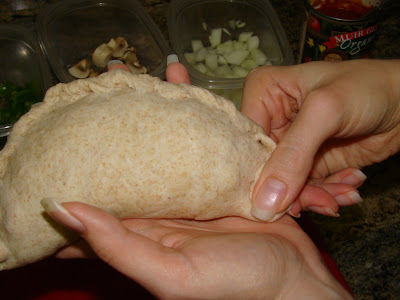
9. After you have pinched it entirely closed, lay the calzone on it's side on the greased cookie sheet. "Paint" a thin layer of olive oil across the top surface and sprinkle with sesame seeds and garlic herb seasoning. Bake for 30 minutes or until it just starts to brown.

10. Enjoy! Look how yummy!

I guess you could call these "Dairy-free Calzones."
Pizza Dough
Ingredients:
*1 package active dry yeast
*About 4 1/2 cups all purpose flour (We actually use 3 to 3 1/2 cups of all purpose and 1 to 1 1/2 cups of whole wheat. The whole wheat makes the dough stronger, so it won't rip as easily while you're forming the calzones, PLUS it's good for you.)
*1 tsp. salt
*1 1/2 cups water
Directions:
1. In large bowl, combine yeast, 2 cups flour and 1 teaspoon salt. In 1-quart saucepan over low heat, heat water until very warm (120 to 130 degrees F). With mixer (KitchenAid with dough hook) at low speed, just blend water into dry ingredients. At medium speed, beat 2 minutes, occasionally scraping bowl with rubber spatula. Beat in 1/2 cup flour to make a thick batter; beat 2 minutes more. Stir (or continue using dough hook) in about 1 1/2 cups flour to make a soft dough.
2. On floured surface (or continuing with dough hook), knead dough about 8 minutes, adding more flour if needed (dough should not stick to the bowl or your fingers-it should have a nice smooth finish. Sometimes I find that I have to add quite a bit more flour--sometimes 1/2 cup or more.). Shape into ball; place in greased large bowl; cover; let rise until doubled, about 1 hour. Once it has risen, punch down dough.


3. On a cutting board (or other "cutting-friendly" surface), form the dough into a rounded mound, and with a large knife, cut into 8 equal slices-just like you're cutting slices of pizza. Form each section into a ball, set aside and cover for another 10-15 minutes.


4. Preheat oven to 350 degrees F. Grease a large cookie sheet. (I use aluminum foil on the cookie sheet for easy cleanup and spread a little bit of olive or grapeseed oil over the surface of the foil.)
5. On the same cutting board (or other surface) you used in step 3, shape one ball of dough at a time into a 6-8 inch circle. Use your fingers for better control, since you want to strive for a circle-not a "funky" oblong. =) Once your circle is formed, begin by spreading pizza sauce on the dough, making sure to avoid the outer 1/2 inch to 1 inch edge to ensure good closure. (We like Muir Glen pizza sauce.)


6. Choose your favorite pizza toppings to "stuff" inside your calzone. We like Italian chicken or turkey sausage, onions, peppers, mushrooms, black olives and jalapenos. If your kids don't like to eat their greens, you can "sneak" some in by cutting up some spinach leaves to toss into the mix. (FYI...If you don't already, you should be encouraging your child(ren) to try new things every now and then. They will never learn to like their veggies if you don't introduce some to them. Your life will be so much easier down the road, if you just put forth the "effort" now!)

7. Once you have added all the desired toppings, grab the center of the edge of dough closest to you and the center edge of dough straight across and bring them straight up to meet in the center; Pinch firmly to hold.

8. Work across one side, pinching all the way across. Once one side is completely closed, very carefully pick up the entire calzone, making sure to replace any toppings that may fall out. With the open end facing up, carefully push any excess toppings towards the closed side to make it easier to close the rest of the calzone. (We usually over stuff ours.) =) I also try to fold over the pinched edges to try to prevent it from splitting open and leaking while cooking. It also gives it a little more purposeful and decorative finish. =)


9. After you have pinched it entirely closed, lay the calzone on it's side on the greased cookie sheet. "Paint" a thin layer of olive oil across the top surface and sprinkle with sesame seeds and garlic herb seasoning. Bake for 30 minutes or until it just starts to brown.

10. Enjoy! Look how yummy!

Friday, July 18, 2008
Dairy Disaster
As promised, here is the information on dairy. I know it is lengthy, but there is a lot of good stuff here that you need to know. Please take the time to read through this at least once. I don't generally write long posts, unless I feel compelled to share something very important with others. =)
Common Sense
Why do mammal mothers produce milk? For the sole purpose of nurturing their babies. Horses produce milk for their babies, sheep produce milk for their babies, cows produce milk for their babies, humans produce milk for their babies, etc.
Can you name an animal that continues to take its mother's milk after it is grown? Can you name an animal that drinks the milk of a different species? No, you can't, because it doesn't happen.
What about Calcium?
Why do humans think that it is necessary to drink the milk from cows after we are weaned from our mothers? One of the biggest reasons is because we are taught from a young age that we need to "drink our milk" for strong teeth and bones. Who tells us that? The dairy industry!
If mammals needed to drink mammal milk for strong teeth and bones, then how do cows, and elephants and other animals get enough calcium for their big bones? They don't continue to drink their mother's milk or the milk from other mammals to ensure their strong teeth and bones. They receive the calcium they need from the plants they eat. The plants have large amounts of magnesium necessary for the body to absorb and use the calcium. Equal parts of calcium and magnesium have to be present in order for proper absorption to take place. The USDA says that a 1 cup serving of milk has 291.336 mg of calcium and 32.794 mg of magnesium, so all that calcium is not doing you one bit of good since only 11% of it could possibly be absorbed.
When the thought of cutting dairy from one's diet comes up, most people immediately fill with the fear of osteoporosis, and that is exactly what the dairy industry wants you to do. The belief that osteoporosis is caused by calcium deficiency is one of the biggest myths around. Mark Hegsted, a retired Harvard professor of nutrition, has said, "To assume that osteoporosis is due to calcium deficiency is like assuming that infection is due to penicillin deficiency." Bone loss and deteriorating bone tissue that take place in osteoporosis are due not to calcium deficiency but rather to its resorption. It's not that our bodies don't get enough calcium, but that they excrete too much of what they already have.
What causes that, you ask? A diet high in protein causes your body to become acidic and will cause your blood stream to leach alkaline substances (like the calcium from our bones) in order to balance the body's PH. (Incidentally, here is a list of acidic and alkaline foods to help you know how to balance your diet.) One solution is not necessarily to increase your calcium intake but to decrease the amount of protein consumed. Americans are among the biggest consumers of dairy in the world, and yet we still have the highest rate of osteoporosis in the world. In this view, it seems that dairy products do indeed cause, rather than prevent, osteoporosis.
Illnesses Caused by Dairy Consumption
Cows milk is intended to nurture a 70-100 pound calf that will reach 140-200 pounds in a month and a half! Is it any wonder that Americans struggle with obesity? Cows also have 2 stomachs that aid in the digestion of their mother's milk which contains curd that is tough and dense making it difficult for humans to digest. Dairy products can easily be considered a health hazard due to the fact that they contain no fiber or complex carbohydrates and are filled with saturated fat and cholesterol.
The following italicized paragraphs are taken from an article discussing how cow's milk is not healthy for humans. (Click here to read the entire article.)
Another reason many people suffer various symptoms of disease from drinking milk is that, according to Dr. Oski, the majority of the world's adult population is "lactose intolerant," meaning they cannot digest lactose, the sugar in milk (cow's milk and human milk). An enzyme known as lactase is required to digest lactose, and Dr. Oski states that "between the age of one and a half and four years most individuals gradually lose the lactase activity in their small intestine. This appears to be a normal process that accompanies maturation.... Most people do it. All animals do it. It reflects the fact that nature never intended lactose-containing foods, such as milk, to be consumed after the normal weaning period."...
...Another serious problem caused by consumption of cow's milk is iron-deficiency anemia. Dr. Oski notes that 15 to 20 percent of children under age 2 in the U.S. suffer from iron-deficiency anemia. Cow's milk contributes to this condition in two ways. First, he notes that cow's milk is extremely low in iron, containing less than 1 milligram of iron per quart. Because of this, he writes that it is estimated that a 1-year-old would need to drink 24 quarts of cow's milk a day to meet his iron requirements, which would be impossible. He states many infants may drink from one to two quarts of cow's milk a day, which satisfies their hunger to the point that they do no have the appetite to consume enough of other foods that do have a high iron content. The second way that cow's milk leads to iron-deficiency anemia in many infants is a form of gastrointestinal bleeding caused by increased mucus and diarrhea associated with dairy consumption. "It is estimated that half the iron-deficiency in infants in the United States is primarily the result of this form of cow milk induced gastrointestinal bleeding," Dr. Oski writes. "Mucus is frequent and some stools contain obvious traces of bright red blood... The diarrhea impairs the infant's ability to retain nutrients from his feedings. In addition, the changes produced in the gastrointestinal tract by the allergic reaction result in seepage of the child's own blood into the gut. This loss of plasma and red cells leads to a lowering of the infant's blood protein level and to the development of anemia."
The mucus created by dairy products causes other problems as well. It is well-known that dairy products cause excessive mucus in the lungs, sinuses and intestines. Dr. Ellis notes this excess mucus in the breathing passages contributes to many respiratory problems and that mucus hardens to form a coating on the inner wall of the intestines that leads to poor absorption of nutrients, which can cause chronic fatigue. This mucus also causes constipation, which can lead to many other problems. Two very common problems with infants are colic and ear infections, both of which can be caused by cow's milk. Medical studies have found cow's milk can contribute to these problems either directly, when the infant drinks cow's milk, or indirectly, when the infant breast feeds from a mother who has been consuming dairy products. Colic, suffered by one out of every five infants in the U.S., is characterized by severe stomach cramps. The July/August 1994 issue of Natural Health reports, "When a mother eats dairy products, milk proteins pass into her breast milk and end up in the baby's blood; some studies have found that cow's milk proteins (from milk drunk by the mother) might trigger colick-like symptoms in infants fed only human milk and no cow's milk." Concerning ear infections, Dr. Northrup states, "You just don't see this painful condition among infants and children who aren't getting cow's milk into their systems." The Natural Health article also notes, "Removing dairy from the diet has been shown to shrink enlarged tonsils and adenoids, indicating relief for the immune system. Similarly, doctors experimenting with dairy-free diets often report a marked reduction in colds, flus, sinusitis and ear infections."
Interesting (and Disgusting) Facts about Dairy
Milk's Basic Contents:
*ALL cow's milk (regular and 'organic') has 59 active hormones, scores of allergens, fat and cholesterol. Most cow's milk has measurable quantities of herbicides, pesticides, dioxins (up to 200 times the safe levels), up to 52 powerful antibiotics (perhaps 53, with LS-50), blood, pus, feces, bacteria and viruses.
*80% of the protein in milk is casein. Casein is a powerful binder, a polymer used to make plastics and a glue that is better used to make sturdy furniture or hold bottle labels in place. It can be found in thousands of processed foods as a binder named "something" caseinate.
Cancer Fuel:
*Of those 59 hormones, one is a powerful GROWTH hormone called Insulin- like Growth Factor ONE (IGF-1). By a freak of nature it is identical in cows and humans. Consider this hormone to be a "fuel cell" for any cancer... (the medical world says IGF-1 is a key factor in the rapid growth and proliferation of breast, prostate and colon cancers, and we suspect that most likely it will be found to promote ALL cancers). IGF-1 is a normal part of ALL milk... the newborn is SUPPOSED to grow quickly! What makes the 50% of obese American consumers think they need MORE growth?
Quantity:
*Each bite of hard cheese has TEN TIMES whatever was in that sip of milk, because it takes ten pounds of milk to make one pound of cheese. Each bite of ice cream has 12 times, and every swipe of butter 21 times whatever is contained in the fat molecules in a sip of milk.
Cholesterol:
*The cholesterol content of three glasses of milk (the recommended daily "dose") is equal to what one would get from 53 slices of bacon. Do you know of any doctor who recommends that much bacon per day?
Mad Cow Disease:
*There may also be prions (pronounced PREons) in the milk and meat. This is crystalline substance that acts like a virus... with an "incubation" period of 5 to 30 years. The end result is MAD COW DISEASE!
Homogenization:
*Large fat molecules cannot get through the intestinal wall into the bloodstream. The cream no longer rises... because homogenization breaks up those large molecules into small ones that DO get into the bloodstream! This becomes an expressway for any fat-borne toxins (lead, dioxins, etc.) into your (otherwise) most protected organs.
Bacteria:
*Cow's milk is allowed to have feces in it. This is a major source for bacteria. Milk is typically pasteurized more than once before it gets to your table - each time for only 15 seconds at 162 degrees Fahrenheit. To sanitize water one is told to boil it (212 degrees F) for several minutes. That's a real comfort, isn't it? Keep in mind that at room temperature the number of bacteria in milk DOUBLE around every 20 minutes. No wonder milk turns rotten very quickly.
*ONE cubic centimeter (cc) of commercial cow's milk is allowed to have up to 750,000 somatic cells (common name is "PUS") and 20,000 live bacteria before it is kept off the market. That amounts to a whopping 20 million live squiggly bacteria and up to 750 MILLION pus cells per liter (a little more than 1/4 gallon).
1 cup = 236.5882cc 177,441,150 pus cells ~ 4,731,600 bacteria
24 oz (3 glasses) = 532,323,450 pus cells ~ 14,220,000 bacteria
(the "recommended" daily intake)
Mistreatment of Cows:
*With genetic manipulation and intensive production technologies, it is common for modern dairy cows to produce 100 pounds of milk a day— 10 times more than they would produce in nature. To keep milk production as high as possible, farmers artificially inseminate cows every year. Growth hormones and unnatural milking schedules cause dairy cows' udders to become painful and so heavy that they sometimes drag on the ground, resulting in frequent infections and overuse of antibiotics.
Quote:
*"It's not natural for humans to drink cow's milk. Human's milk is for humans. Cow's milk is for calves. You have no more need of cow's milk than you do rat's milk, horse's milk or elephant's milk. Cow's milk is a high fat fluid exquisitely designed to turn a 65 lb. baby calf into a 400 lb. cow. That's what cow's milk is for!" --Dr Michael Klaper MD
Alternatives to Dairy
In our opinion, soy milk is an excellent substitution for cow's milk when used with cereal or even in cooking and baking. I know that there has to be some of you who inwardly cringe at the thought of even trying soy milk, let alone consuming it on a regular basis, but let me tell you, soy milk is good! My mother and I are living proof that even thepickiest most discerning person will enjoy having soy milk. My mom, who (like me) is very sensitive to trying strange, new things, recently started using soy milk in her cereal. She conveyed to me that when she sat down with her first bowl, she gagged a little at the thought, but once she took her first bite, she thought, "Wow! What a treat!" Now, she completely looks forward to it. So far, she has only tried the vanilla-flavored Silk soy milk. I find that kind to be a little too sweet for my liking (especially with a sweeter cereal), so we use the regular soy milk. We are not brand-loyal yet. We just look for the best price, so when Silk is on sale, we get that. When it's not, I use my $1 off coupon on Organic Valley soy milk.
Another good substitution is coconut milk. Remember the strawberry coconut milk ice cream? That stuff is good! Coconut milk is thicker than cow's milk, so it makes for a rich, creamy ice cream. This recipe was originally for chocolate coconut milk ice cream, but we just changed it to strawberry for Larissa's birthday party. The chocolate ice cream was good, but you have to be sure to really mix in the cocoa powder completely. There were a few little "balls" of cocoa powder towards the bottom of the ice cream churn container, but for the most part it was fine. The recipe is the same, but instead of the strawberries, use 2/3 cup of cocoa powder in the single recipe. Oh, and in case you are wondering, coconut milk does not have a strong coconut flavor. In fact, I don't think it really tastes like coconut at all, especially after you've added the strawberry or chocolate to it.
As far as cheese goes, we haven't found a really good substitution. There are soy cheeses, but I haven't been too impressed with them. Jason and the girls thought it was fine, but I'm a little pickier than they are, I guess. =) If you decide to try a cheese substitute, make sure you look at the ingredient list. We found a rice cheese a couple of months ago, and since we used to get rice milk years ago, we thought the rice cheese would also be dairy free. After we tried it, we thought, "Wow! That was great!" Come to find out, they put casein in the mix. So, we haven't had it since.
Right now, we have some soy cream cheese in the refrigerator that we plan on using in one of our favorite cheesecake recipes. We're desperately trying to come up with some good holiday substitutions BEFORE the holidays get here, and since that is basically 4 months away, we are in a time crunch! When I come across good recipes, I'll post them for you to try.
If you have any questions or comments about this post, let me know. I hope that this has been helpful and informative. =)
Common Sense
Why do mammal mothers produce milk? For the sole purpose of nurturing their babies. Horses produce milk for their babies, sheep produce milk for their babies, cows produce milk for their babies, humans produce milk for their babies, etc.
Can you name an animal that continues to take its mother's milk after it is grown? Can you name an animal that drinks the milk of a different species? No, you can't, because it doesn't happen.
What about Calcium?
Why do humans think that it is necessary to drink the milk from cows after we are weaned from our mothers? One of the biggest reasons is because we are taught from a young age that we need to "drink our milk" for strong teeth and bones. Who tells us that? The dairy industry!
If mammals needed to drink mammal milk for strong teeth and bones, then how do cows, and elephants and other animals get enough calcium for their big bones? They don't continue to drink their mother's milk or the milk from other mammals to ensure their strong teeth and bones. They receive the calcium they need from the plants they eat. The plants have large amounts of magnesium necessary for the body to absorb and use the calcium. Equal parts of calcium and magnesium have to be present in order for proper absorption to take place. The USDA says that a 1 cup serving of milk has 291.336 mg of calcium and 32.794 mg of magnesium, so all that calcium is not doing you one bit of good since only 11% of it could possibly be absorbed.
When the thought of cutting dairy from one's diet comes up, most people immediately fill with the fear of osteoporosis, and that is exactly what the dairy industry wants you to do. The belief that osteoporosis is caused by calcium deficiency is one of the biggest myths around. Mark Hegsted, a retired Harvard professor of nutrition, has said, "To assume that osteoporosis is due to calcium deficiency is like assuming that infection is due to penicillin deficiency." Bone loss and deteriorating bone tissue that take place in osteoporosis are due not to calcium deficiency but rather to its resorption. It's not that our bodies don't get enough calcium, but that they excrete too much of what they already have.
What causes that, you ask? A diet high in protein causes your body to become acidic and will cause your blood stream to leach alkaline substances (like the calcium from our bones) in order to balance the body's PH. (Incidentally, here is a list of acidic and alkaline foods to help you know how to balance your diet.) One solution is not necessarily to increase your calcium intake but to decrease the amount of protein consumed. Americans are among the biggest consumers of dairy in the world, and yet we still have the highest rate of osteoporosis in the world. In this view, it seems that dairy products do indeed cause, rather than prevent, osteoporosis.
Illnesses Caused by Dairy Consumption
Cows milk is intended to nurture a 70-100 pound calf that will reach 140-200 pounds in a month and a half! Is it any wonder that Americans struggle with obesity? Cows also have 2 stomachs that aid in the digestion of their mother's milk which contains curd that is tough and dense making it difficult for humans to digest. Dairy products can easily be considered a health hazard due to the fact that they contain no fiber or complex carbohydrates and are filled with saturated fat and cholesterol.
The following italicized paragraphs are taken from an article discussing how cow's milk is not healthy for humans. (Click here to read the entire article.)
People who have been taught that cow's milk is the "perfect food" may be shocked to hear many prominent medical doctors are now saying dairy consumption is a contributing factor in nearly two dozen diseases of children and adults.
Doctors say cow's milk can lead to iron deficiency anemia, allergies, diarrhea, heart disease, colic, cramps, gastrointestinal bleeding, sinusitis, skin rashes, acne, increased frequency of colds and flus, arthritis, diabetes, ear infections, osteoporosis, asthma, autoimmune diseases, and more, possibly even lung cancer, multiple sclerosis and non-Hodgkin's lymphoma...
...Dr. Michael Taylor states, "It is a dietary error to cross species to get milk from another animal." He notes there is a tremendous difference between human babies and baby calves, and a corresponding difference between the milk that is intended to nourish human babies and baby calves. In an interview, Dr. Taylor notes that human infants take about 180 days to double their birth weight, and that human milk is 5 to 7 percent protein. Calves require only 45 days to double their birth weight and cow's milk is 15 percent protein. In addition to the difference in the amount of protein in these two different types of milk, there are also major differences in the composition of this protein. The primary type of protein in cow's milk is casein. Cow's milk has 20 times as much casein as human milk, which makes the protein from cow's milk difficult or impossible for humans to assimilate, according to Dr. John R. Christopher, N.D., M.H. Protein composes 15 percent of the human body and when this protein cannot be properly broken down, it weakens the immune system, causing allergies and many other problems. Allergies caused by cow's milk are extremely common. In fact, Dr. Taylor states that when a single food can be isolated as the cause of an allergy, 60 percent of the time, that food is cow's milk. Dr. Ellis notes that symptoms of this allergic reaction to cow's milk in infants can include asthma, nasal congestion, skin rash, chest infections, irritability and fatigue. Dr. Oski's book cites evidence from Dr. Joyce Gryboski, director of the Pediatric Gastrointestinal Clinic at Yale University School of Medicine, who states "they see at least one child a week who is referred for evaluation of chronic diarrhea and proves to have nothing more than an allergy to cow milk."
Doctors say cow's milk can lead to iron deficiency anemia, allergies, diarrhea, heart disease, colic, cramps, gastrointestinal bleeding, sinusitis, skin rashes, acne, increased frequency of colds and flus, arthritis, diabetes, ear infections, osteoporosis, asthma, autoimmune diseases, and more, possibly even lung cancer, multiple sclerosis and non-Hodgkin's lymphoma...
...Dr. Michael Taylor states, "It is a dietary error to cross species to get milk from another animal." He notes there is a tremendous difference between human babies and baby calves, and a corresponding difference between the milk that is intended to nourish human babies and baby calves. In an interview, Dr. Taylor notes that human infants take about 180 days to double their birth weight, and that human milk is 5 to 7 percent protein. Calves require only 45 days to double their birth weight and cow's milk is 15 percent protein. In addition to the difference in the amount of protein in these two different types of milk, there are also major differences in the composition of this protein. The primary type of protein in cow's milk is casein. Cow's milk has 20 times as much casein as human milk, which makes the protein from cow's milk difficult or impossible for humans to assimilate, according to Dr. John R. Christopher, N.D., M.H. Protein composes 15 percent of the human body and when this protein cannot be properly broken down, it weakens the immune system, causing allergies and many other problems. Allergies caused by cow's milk are extremely common. In fact, Dr. Taylor states that when a single food can be isolated as the cause of an allergy, 60 percent of the time, that food is cow's milk. Dr. Ellis notes that symptoms of this allergic reaction to cow's milk in infants can include asthma, nasal congestion, skin rash, chest infections, irritability and fatigue. Dr. Oski's book cites evidence from Dr. Joyce Gryboski, director of the Pediatric Gastrointestinal Clinic at Yale University School of Medicine, who states "they see at least one child a week who is referred for evaluation of chronic diarrhea and proves to have nothing more than an allergy to cow milk."
Another reason many people suffer various symptoms of disease from drinking milk is that, according to Dr. Oski, the majority of the world's adult population is "lactose intolerant," meaning they cannot digest lactose, the sugar in milk (cow's milk and human milk). An enzyme known as lactase is required to digest lactose, and Dr. Oski states that "between the age of one and a half and four years most individuals gradually lose the lactase activity in their small intestine. This appears to be a normal process that accompanies maturation.... Most people do it. All animals do it. It reflects the fact that nature never intended lactose-containing foods, such as milk, to be consumed after the normal weaning period."...
...Another serious problem caused by consumption of cow's milk is iron-deficiency anemia. Dr. Oski notes that 15 to 20 percent of children under age 2 in the U.S. suffer from iron-deficiency anemia. Cow's milk contributes to this condition in two ways. First, he notes that cow's milk is extremely low in iron, containing less than 1 milligram of iron per quart. Because of this, he writes that it is estimated that a 1-year-old would need to drink 24 quarts of cow's milk a day to meet his iron requirements, which would be impossible. He states many infants may drink from one to two quarts of cow's milk a day, which satisfies their hunger to the point that they do no have the appetite to consume enough of other foods that do have a high iron content. The second way that cow's milk leads to iron-deficiency anemia in many infants is a form of gastrointestinal bleeding caused by increased mucus and diarrhea associated with dairy consumption. "It is estimated that half the iron-deficiency in infants in the United States is primarily the result of this form of cow milk induced gastrointestinal bleeding," Dr. Oski writes. "Mucus is frequent and some stools contain obvious traces of bright red blood... The diarrhea impairs the infant's ability to retain nutrients from his feedings. In addition, the changes produced in the gastrointestinal tract by the allergic reaction result in seepage of the child's own blood into the gut. This loss of plasma and red cells leads to a lowering of the infant's blood protein level and to the development of anemia."
The mucus created by dairy products causes other problems as well. It is well-known that dairy products cause excessive mucus in the lungs, sinuses and intestines. Dr. Ellis notes this excess mucus in the breathing passages contributes to many respiratory problems and that mucus hardens to form a coating on the inner wall of the intestines that leads to poor absorption of nutrients, which can cause chronic fatigue. This mucus also causes constipation, which can lead to many other problems. Two very common problems with infants are colic and ear infections, both of which can be caused by cow's milk. Medical studies have found cow's milk can contribute to these problems either directly, when the infant drinks cow's milk, or indirectly, when the infant breast feeds from a mother who has been consuming dairy products. Colic, suffered by one out of every five infants in the U.S., is characterized by severe stomach cramps. The July/August 1994 issue of Natural Health reports, "When a mother eats dairy products, milk proteins pass into her breast milk and end up in the baby's blood; some studies have found that cow's milk proteins (from milk drunk by the mother) might trigger colick-like symptoms in infants fed only human milk and no cow's milk." Concerning ear infections, Dr. Northrup states, "You just don't see this painful condition among infants and children who aren't getting cow's milk into their systems." The Natural Health article also notes, "Removing dairy from the diet has been shown to shrink enlarged tonsils and adenoids, indicating relief for the immune system. Similarly, doctors experimenting with dairy-free diets often report a marked reduction in colds, flus, sinusitis and ear infections."
Interesting (and Disgusting) Facts about Dairy
Milk's Basic Contents:
*ALL cow's milk (regular and 'organic') has 59 active hormones, scores of allergens, fat and cholesterol. Most cow's milk has measurable quantities of herbicides, pesticides, dioxins (up to 200 times the safe levels), up to 52 powerful antibiotics (perhaps 53, with LS-50), blood, pus, feces, bacteria and viruses.
*80% of the protein in milk is casein. Casein is a powerful binder, a polymer used to make plastics and a glue that is better used to make sturdy furniture or hold bottle labels in place. It can be found in thousands of processed foods as a binder named "something" caseinate.
Cancer Fuel:
*Of those 59 hormones, one is a powerful GROWTH hormone called Insulin- like Growth Factor ONE (IGF-1). By a freak of nature it is identical in cows and humans. Consider this hormone to be a "fuel cell" for any cancer... (the medical world says IGF-1 is a key factor in the rapid growth and proliferation of breast, prostate and colon cancers, and we suspect that most likely it will be found to promote ALL cancers). IGF-1 is a normal part of ALL milk... the newborn is SUPPOSED to grow quickly! What makes the 50% of obese American consumers think they need MORE growth?
Quantity:
*Each bite of hard cheese has TEN TIMES whatever was in that sip of milk, because it takes ten pounds of milk to make one pound of cheese. Each bite of ice cream has 12 times, and every swipe of butter 21 times whatever is contained in the fat molecules in a sip of milk.
Cholesterol:
*The cholesterol content of three glasses of milk (the recommended daily "dose") is equal to what one would get from 53 slices of bacon. Do you know of any doctor who recommends that much bacon per day?
Mad Cow Disease:
*There may also be prions (pronounced PREons) in the milk and meat. This is crystalline substance that acts like a virus... with an "incubation" period of 5 to 30 years. The end result is MAD COW DISEASE!
Homogenization:
*Large fat molecules cannot get through the intestinal wall into the bloodstream. The cream no longer rises... because homogenization breaks up those large molecules into small ones that DO get into the bloodstream! This becomes an expressway for any fat-borne toxins (lead, dioxins, etc.) into your (otherwise) most protected organs.
Bacteria:
*Cow's milk is allowed to have feces in it. This is a major source for bacteria. Milk is typically pasteurized more than once before it gets to your table - each time for only 15 seconds at 162 degrees Fahrenheit. To sanitize water one is told to boil it (212 degrees F) for several minutes. That's a real comfort, isn't it? Keep in mind that at room temperature the number of bacteria in milk DOUBLE around every 20 minutes. No wonder milk turns rotten very quickly.
*ONE cubic centimeter (cc) of commercial cow's milk is allowed to have up to 750,000 somatic cells (common name is "PUS") and 20,000 live bacteria before it is kept off the market. That amounts to a whopping 20 million live squiggly bacteria and up to 750 MILLION pus cells per liter (a little more than 1/4 gallon).
1 cup = 236.5882cc 177,441,150 pus cells ~ 4,731,600 bacteria
24 oz (3 glasses) = 532,323,450 pus cells ~ 14,220,000 bacteria
(the "recommended" daily intake)
Mistreatment of Cows:
*With genetic manipulation and intensive production technologies, it is common for modern dairy cows to produce 100 pounds of milk a day— 10 times more than they would produce in nature. To keep milk production as high as possible, farmers artificially inseminate cows every year. Growth hormones and unnatural milking schedules cause dairy cows' udders to become painful and so heavy that they sometimes drag on the ground, resulting in frequent infections and overuse of antibiotics.
Quote:
*"It's not natural for humans to drink cow's milk. Human's milk is for humans. Cow's milk is for calves. You have no more need of cow's milk than you do rat's milk, horse's milk or elephant's milk. Cow's milk is a high fat fluid exquisitely designed to turn a 65 lb. baby calf into a 400 lb. cow. That's what cow's milk is for!" --Dr Michael Klaper MD
Alternatives to Dairy
In our opinion, soy milk is an excellent substitution for cow's milk when used with cereal or even in cooking and baking. I know that there has to be some of you who inwardly cringe at the thought of even trying soy milk, let alone consuming it on a regular basis, but let me tell you, soy milk is good! My mother and I are living proof that even the
Another good substitution is coconut milk. Remember the strawberry coconut milk ice cream? That stuff is good! Coconut milk is thicker than cow's milk, so it makes for a rich, creamy ice cream. This recipe was originally for chocolate coconut milk ice cream, but we just changed it to strawberry for Larissa's birthday party. The chocolate ice cream was good, but you have to be sure to really mix in the cocoa powder completely. There were a few little "balls" of cocoa powder towards the bottom of the ice cream churn container, but for the most part it was fine. The recipe is the same, but instead of the strawberries, use 2/3 cup of cocoa powder in the single recipe. Oh, and in case you are wondering, coconut milk does not have a strong coconut flavor. In fact, I don't think it really tastes like coconut at all, especially after you've added the strawberry or chocolate to it.
As far as cheese goes, we haven't found a really good substitution. There are soy cheeses, but I haven't been too impressed with them. Jason and the girls thought it was fine, but I'm a little pickier than they are, I guess. =) If you decide to try a cheese substitute, make sure you look at the ingredient list. We found a rice cheese a couple of months ago, and since we used to get rice milk years ago, we thought the rice cheese would also be dairy free. After we tried it, we thought, "Wow! That was great!" Come to find out, they put casein in the mix. So, we haven't had it since.
Right now, we have some soy cream cheese in the refrigerator that we plan on using in one of our favorite cheesecake recipes. We're desperately trying to come up with some good holiday substitutions BEFORE the holidays get here, and since that is basically 4 months away, we are in a time crunch! When I come across good recipes, I'll post them for you to try.
If you have any questions or comments about this post, let me know. I hope that this has been helpful and informative. =)
Subscribe to:
Posts (Atom)